
Supervision Agreement
At a glance
The supervision agreement
- provides clarity regarding expectations, responsibilities and the planned course of the doctorate
- fosters collaboration between doctoral candidates and supervisors
- provides as guidance for the parties involved
Why should you set up a supervision agreement?

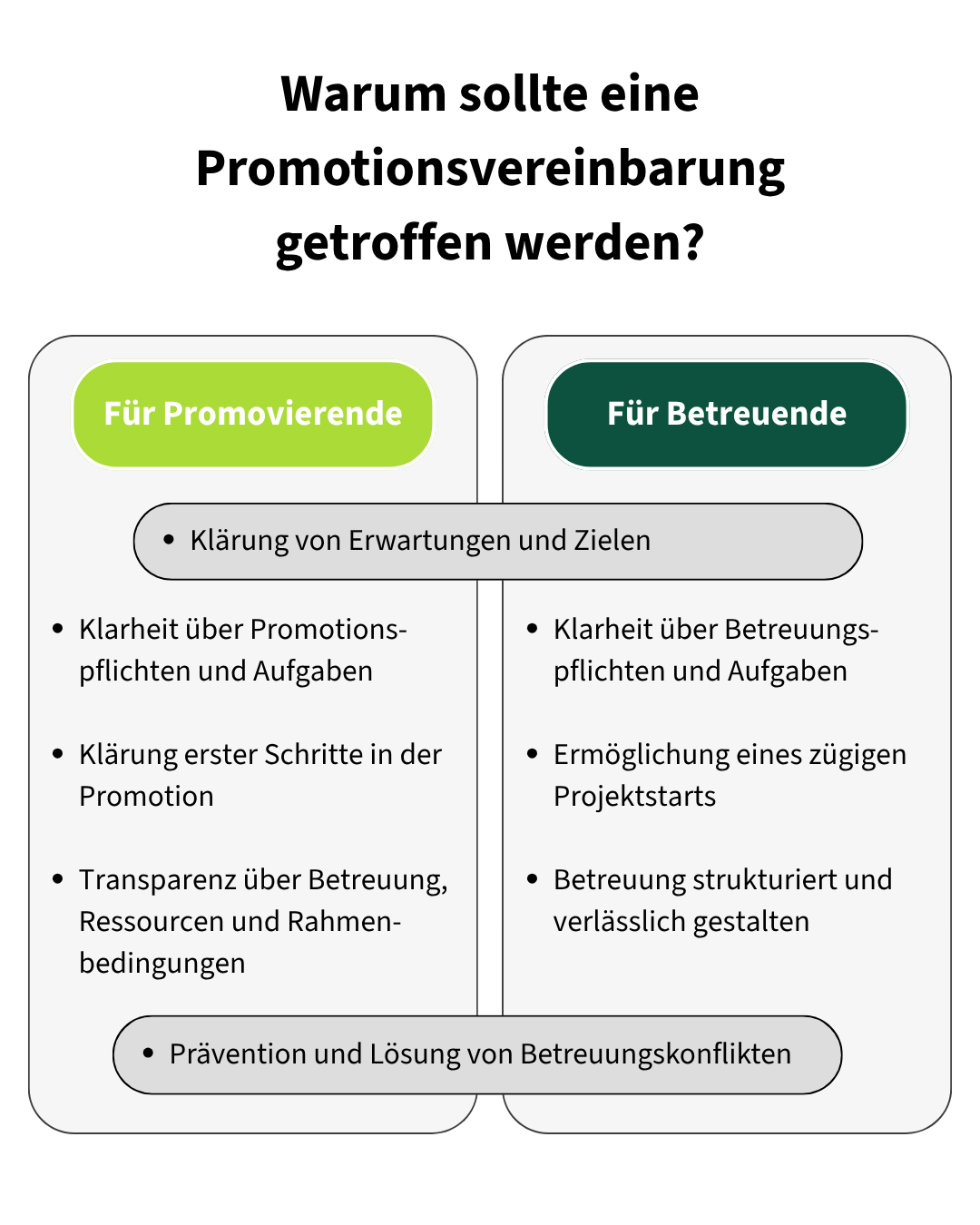
Benefits of a supervision agreement
Orientation
- Set common goals
- Clarify expectations
- Make planning easier
Commitment
- Define roles and responsibilities
- Document mutual agreements
Quality assurance of supervision
- encourage regular exchange
- make progress transparent
- prevent conflicts
What should be included?
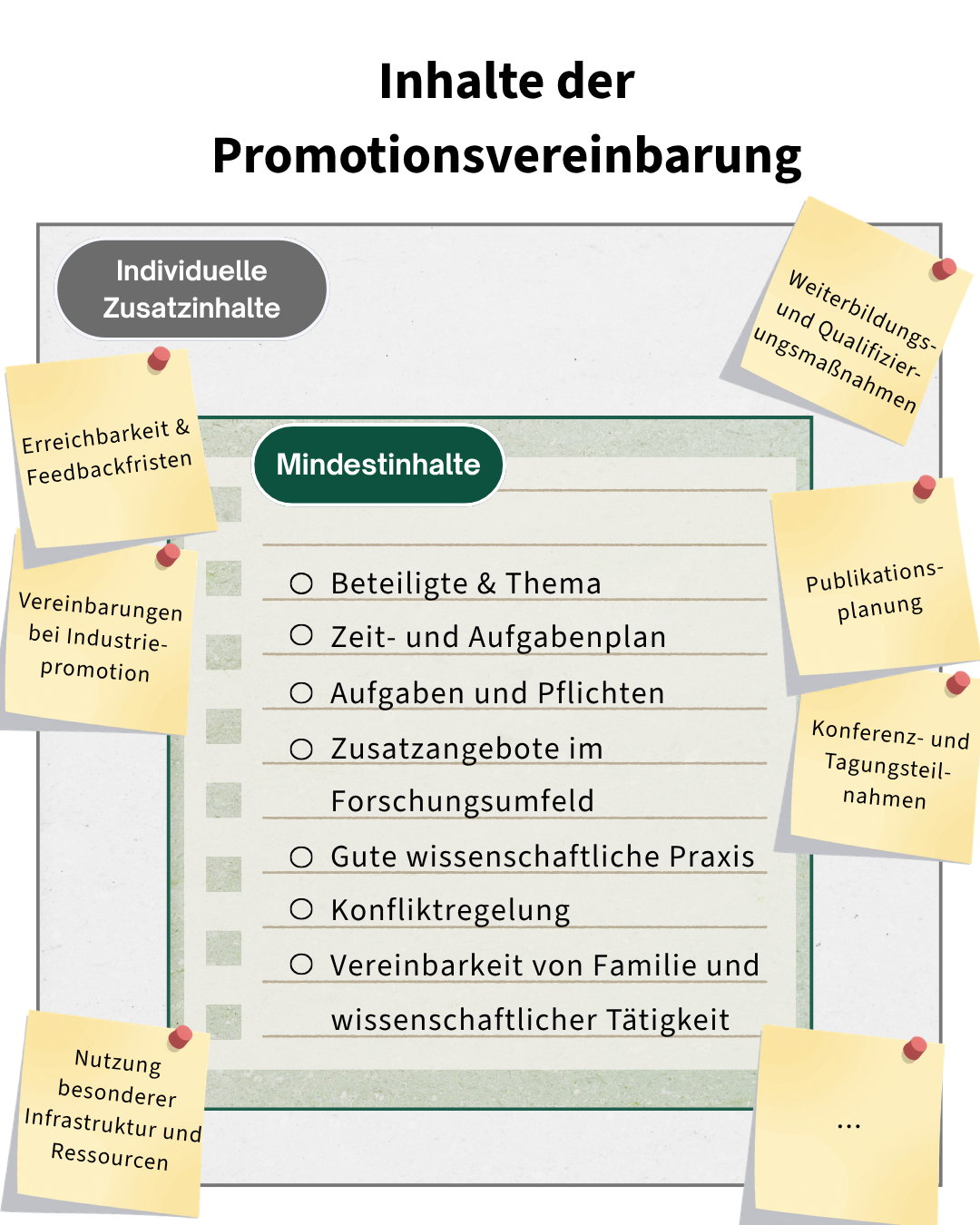
The supervision agreement sets out all the key aspects of the doctorate programme in a joint document. This ensures transparency and helps both parties to establish a clear framework for their collaboration right from the start.
Good to know: The following aspects form the core content of a supervision agreement. Depending on the nature of the doctoral project, further topics may be added and agreed upon on a case-by-case basis.
- Doctoral candidate, supervisor(s) and topic of the dissertation
- Timetable and task plan
- Roles and responsibilities of supervisor(s) and doctoral candidate
- Additional services in the research setting
- Good scientific practice
- Conflict resolution
- Compatibility of family responsibilities and academic work
Setting up a supervision agreement
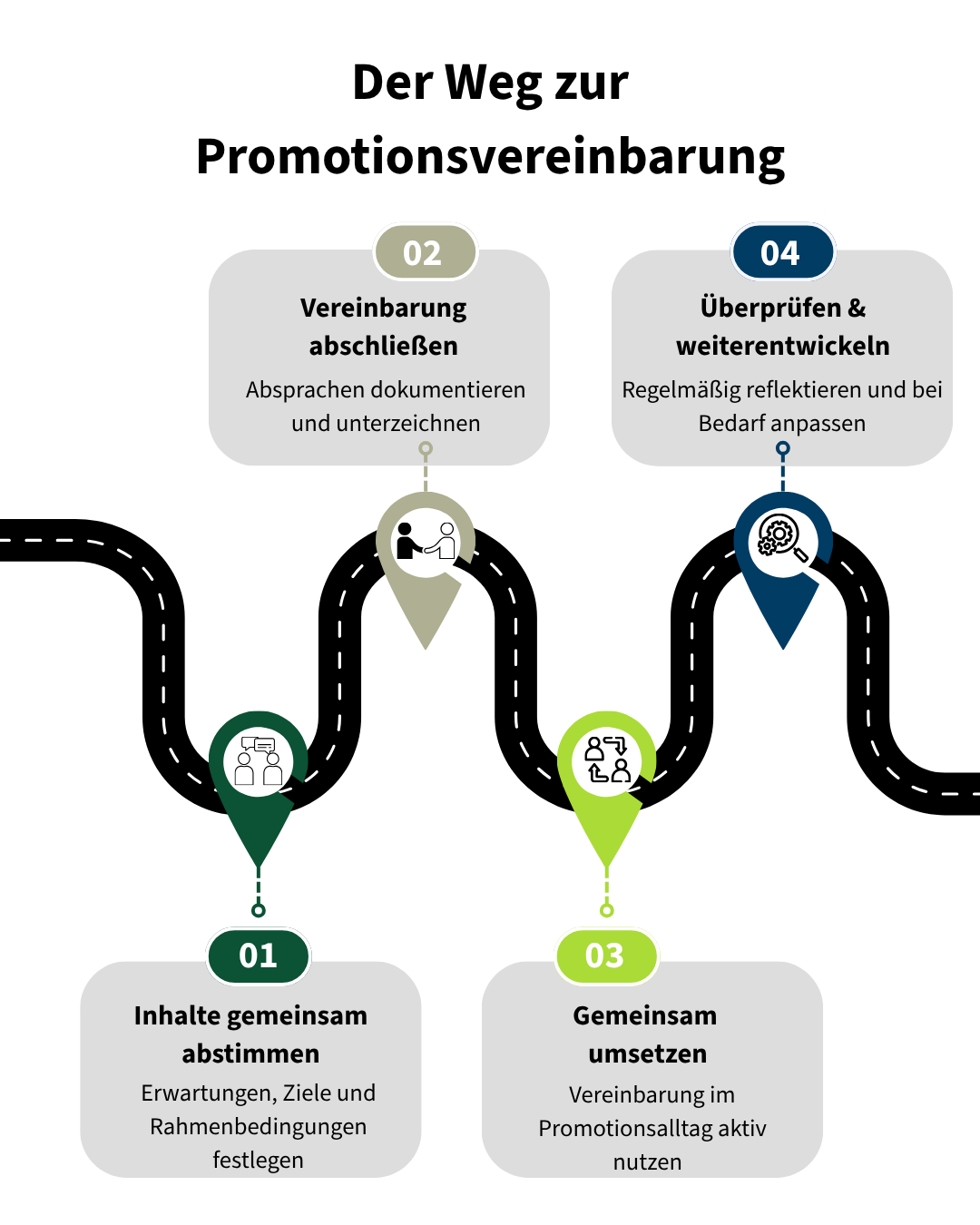
At the beginning, doctoral candidates and their supervisors agree on the key terms and conditions of the doctorate. These include, in particular, the objectives and content of the dissertation, the timetable and work plan, the supervision, and mutual expectations and responsibilities.
The decisions made are set out in writing in the supervision agreement. Our supervision agreement template can be used for this purpose. Once agreed upon, the agreement is signed by the parties involved. It forms a common basis for future collaboration.
The supervision agreement is more than just a document signed once; it serves as a shared basis for collaboration throughout the entire duration of the doctoral programme. The arrangements set out in it should be actively put into practice in day-to-day doctoral work.
The doctorate project may change over time. The agreements reached should therefore be reviewed regularly and amended where necessary. This ensures that any changes – for example, to the timetable and work plan, or to the general conditions of the doctorate programme – can be discussed at an early stage and agreed upon jointly.
Good to know - FAQ
Please check your doctoral regulations to see whether it is compulsory to sign a supervision agreement.
Note: Regardless of the requirements set out in the doctoral regulations, we recommend that you sign a supervision agreement. It helps to set out what is expected of those involved, who is responsible for which tasks, and how the doctorate is planned. However, this only works if the agreements reached are actively put into practice in day-to-day doctoral work.
Although a supervision agreement is structured like a contract, it is not a legally binding contract (e.g. in the sense of an employment contract). This means that neither party can take legal action to enforce compliance with the agreed terms. Nevertheless, the supervision agreement is a document that can be referred to in the event of a legal dispute (Qualitätszirkel Promotion, 2019).
In principle, a supervision agreement can be drawn up at any stage of the doctoral programme. We recommend setting out the arrangements in writing at the start of the supervisory relationship. This ensures that the supervision agreement can serve as a shared working basis from the outset.
Yes. The supervision agreement is not a document to be filed away; rather, it serves as the basis for collaboration. If the general conditions or the course of the dissertation project change, the supervision agreement can be amended jointly at any time. Any changes should be discussed openly between the doctoral candidates and their supervisors and recorded in writing.
If it appears that one party is deviating from the agreed obligations, doctoral candidates and supervisors should first seek to engage in an open discussion with one another in order to restore the terms of the supervision agreement through open and cooperative collaboration, or to amend them by mutual consent. If no agreement can be reached, please contact
- the relevant university advisory services
- the faculty’s doctoral committee
- or the ombudspersons at your university